CNC milling
Where LFAM wins
Printing can use less material than milling a solid block, especially for hollow or organic forms.
Where milling fits
Milling suits precise interfaces and tolerances. Printed parts can also be machined.

Furniture and architectural elements, built layer by layer by a robot.
Get to know the processFlat, horizontal layers build the form from the ground up.
Curved layers rise and fall as they build the form.
Flat layers gradually change direction along a curved path.
Layers follow the contours of an underlying curved mould.
An upright box, built with layers sliced at 45°.
LFAM stands for large-format additive manufacturing.
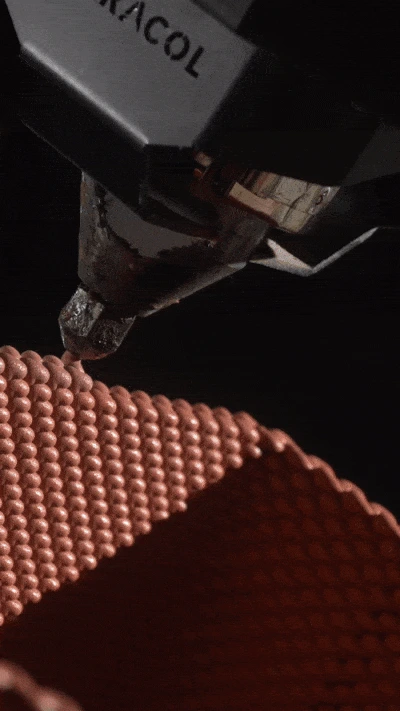
A robot deposits melted polymer or composite pellets along a digital path. Each layer builds on the last.
Curves, hollow forms, open patterns and texture can be printed directly into the piece.
Define the form, dimensions, use and connections.
Plan the print path, layer direction and material.
Heat the pellets and print layer by layer.
Trim, finish and assemble the components.
Useful for complex shapes, custom sizes and smaller production runs.
Curves, meshes and textures can be printed together, reducing separate parts and assembly.
Direct printing avoids a shape-specific mold and its upfront cost, where one would otherwise be needed.
Adapt dimensions, pattern, color and configuration to the project.
Revise the digital model between approved runs without replacing a dedicated shape mold.
Make a one-off, small collection or repeat batch around actual demand.
Choose by form, material, quantity and finish. Some projects combine several processes.
Printing can use less material than milling a solid block, especially for hollow or organic forms.
Milling suits precise interfaces and tolerances. Printed parts can also be machined.
Printing directly suits low quantities or changing forms that would otherwise need new tooling.
Large identical runs may favor molding. Engineered laminates and printed fiber-filled polymers have different performance.
Printing a curve or pattern as one component can reduce cutting and assembly.
Combine printed parts with timber, metalwork, upholstery or precision hardware as needed.
Robotic printing suits furniture-sized forms with fewer small parts to join.
Smaller processes suit fine details and specialist materials. LFAM has larger, visible layers.
Overhangs, orientation, cooling and connections need development. Price and timing include samples, testing, finishing and delivery.
 Geometry / Prudential Center
Modular printed mesh spans three lululemon storefront bays in Boston.
Explore Prudential Center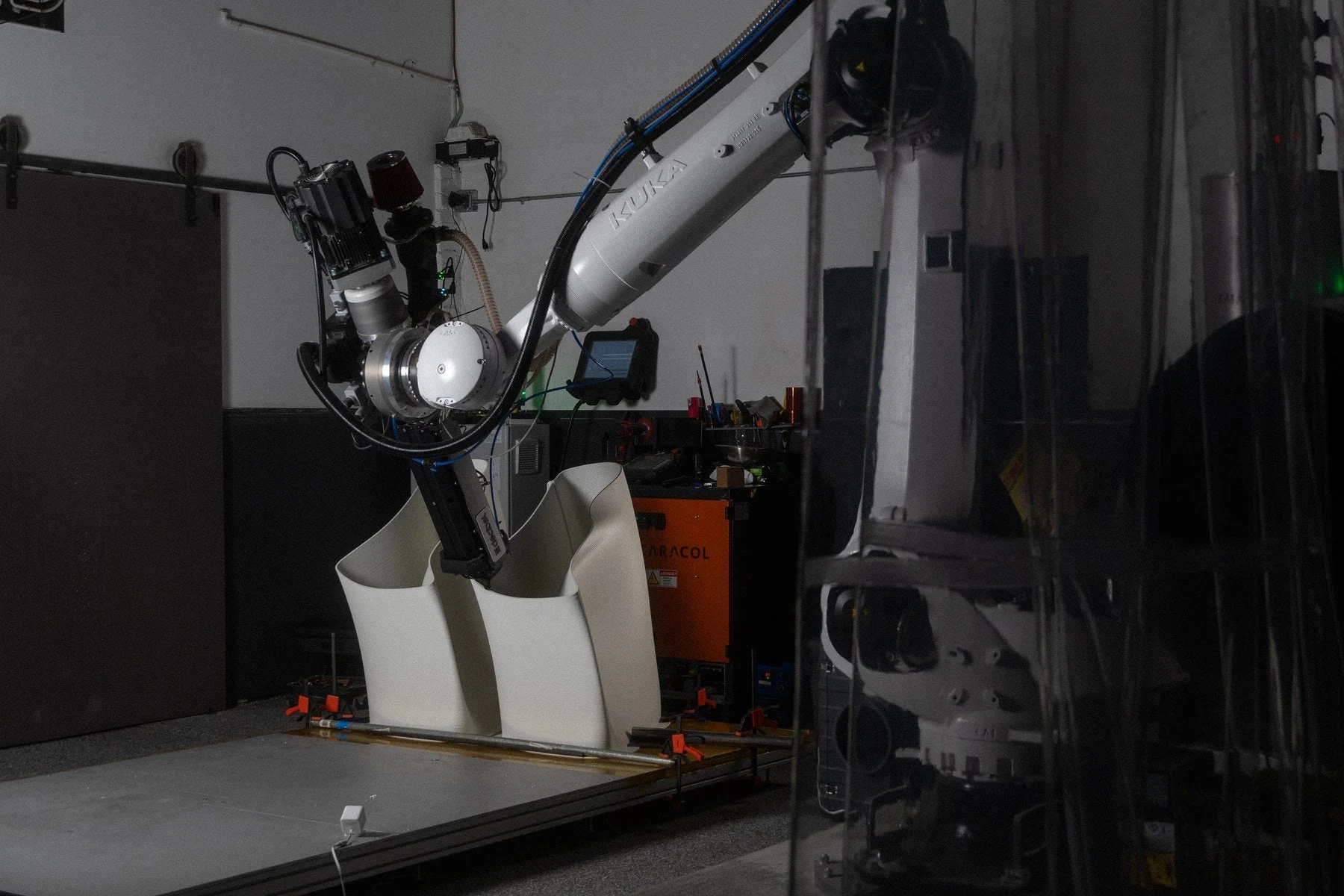 Production / SKYLRK OASIS
Decibel and Caracol produced modular seating for Coachella without dedicated molds.
Explore SKYLRK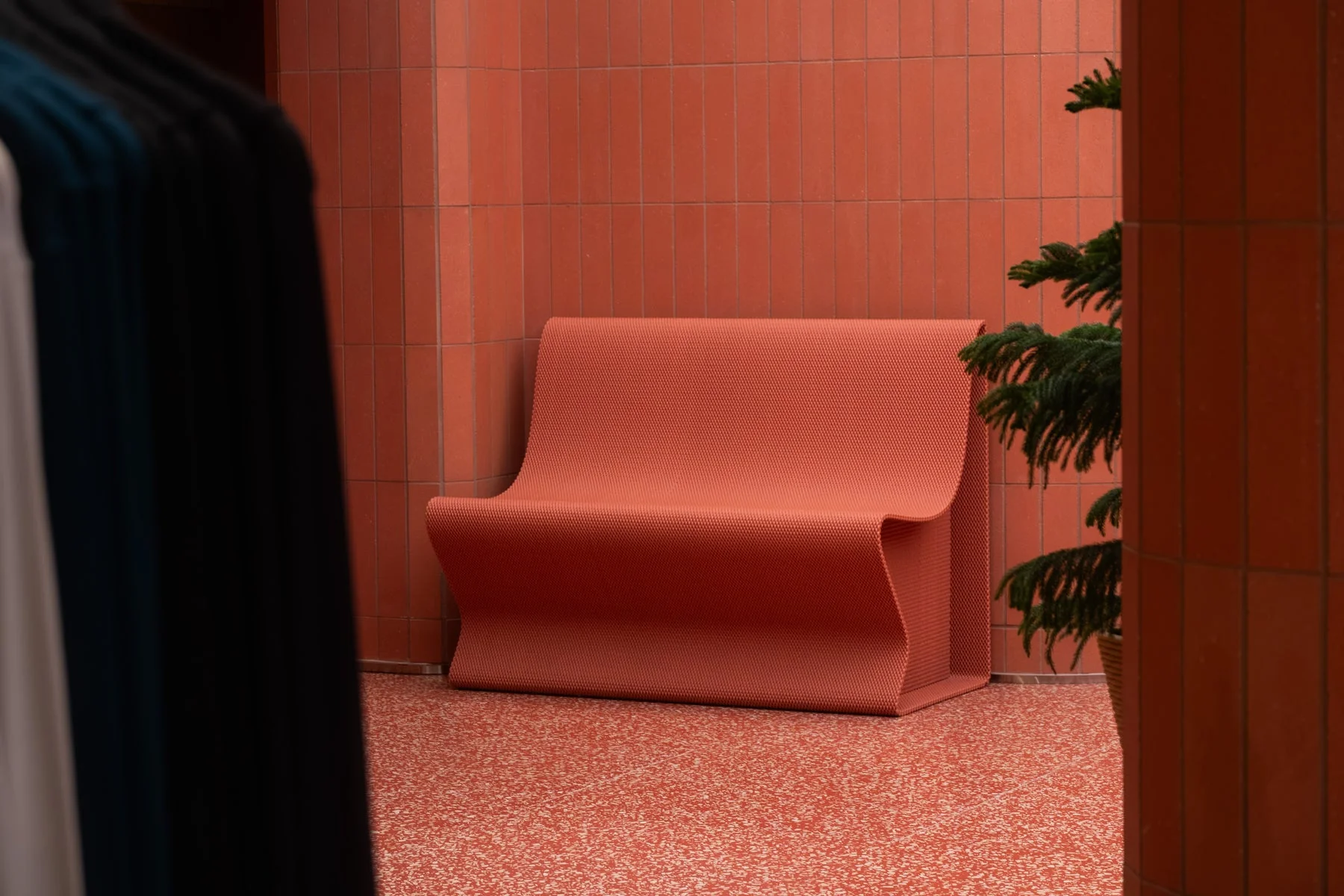 Identity / lululemon SoHo
lululemon’s motif is printed directly into its custom red seating.
Explore SoHoStone-like, wood-like and translucent polymers and composites. Confirm color and finish with physical samples.
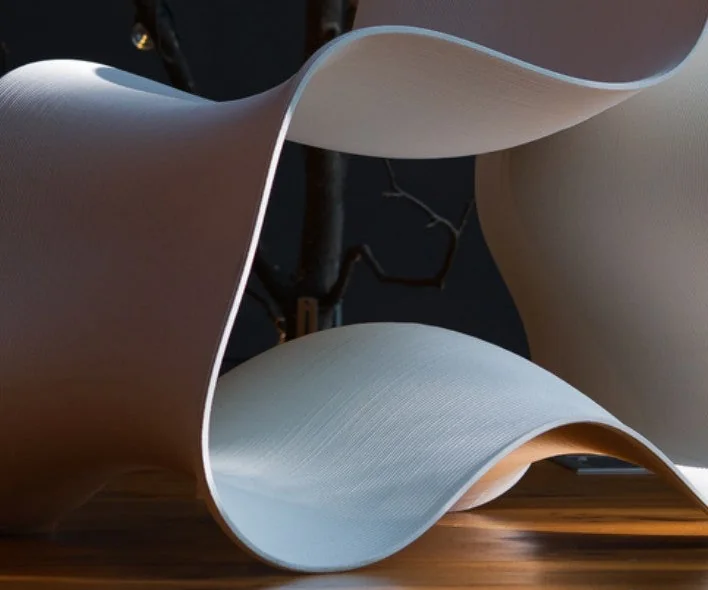
Glass-fiber-reinforced recycled PETG with a matte, stone-like surface. Material and design are reviewed for the intended loads, exposure and cleaning.
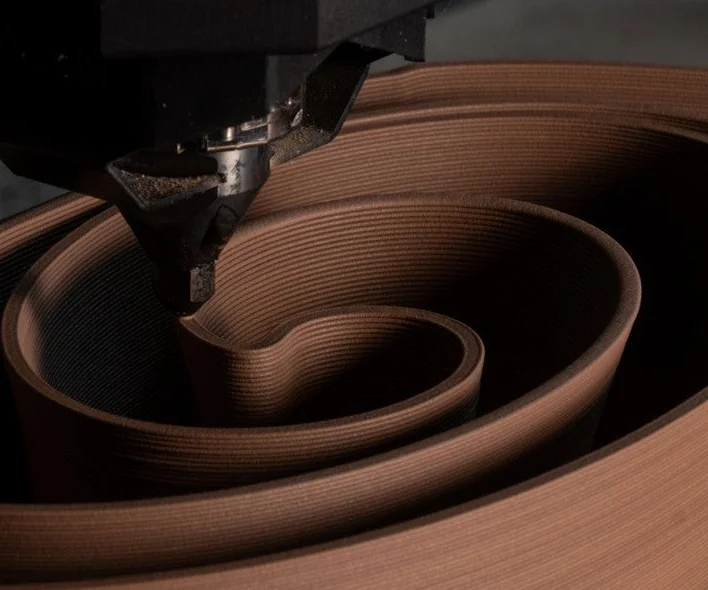
Plant-fiber-reinforced biopolymer with a warm, tactile surface. Samples establish the finish, with moisture, heat, wear and exposure reviewed for the application.
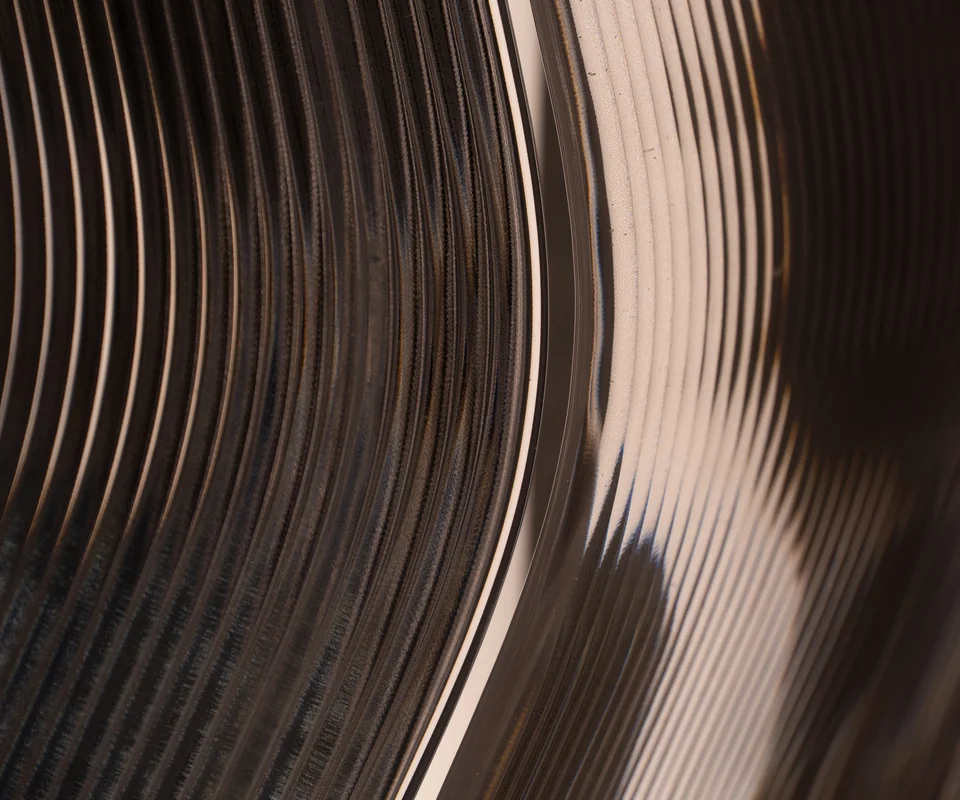
Translucent recycled PETG with depth and light play across its layers. Review samples under the intended lighting and confirm exposure and heat conditions.
Ask about custom colors or material development. Sampling and validation are scoped to the project.
Material, print orientation and assembly determine performance. Samples and relevant testing confirm suitability.
Share any fire, smoke, acoustic or emissions requirements early. We review available documentation for the proposed formulation and identify gaps; recycled or bio-based content alone does not establish lower whole-life impact or biodegradability.
Bring the idea, even if it is still a sketch.
Share the use, site, dimensions, quantity and timing. We’ll assess the production approach.
Discuss your project